Kato's non-lethal policy
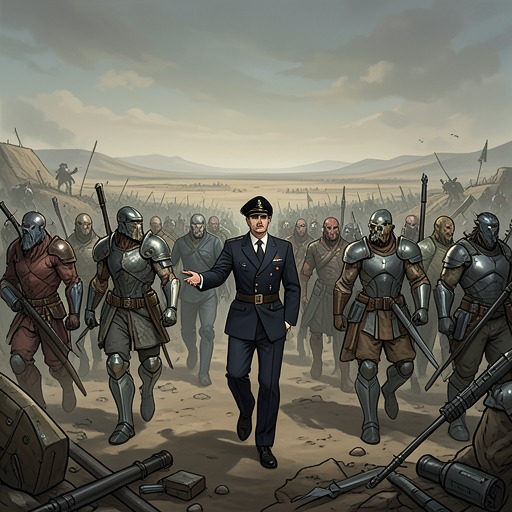
Systema Delenda EstCato's Nonlethal Policy is the central operational ethic of Cato's campaign against the System. Cato's objective is not conquest for its own sake but the removal of an entity that destroyed planets, erased people and cultures, narrowed the choices available to entire civilizations, and turned violence into a mandatory social order. His commitment to avoid killing therefore shapes both his battlefield methods and his political program. It does not make the campaign gentle: Cato attacks dozens of worlds at once, uses orbital weapons, and accepts collateral damage when he judges the System to be an existential threat. The policy instead marks the boundary he tries to preserve between destroying the System and destroying the people trapped inside it.
Definition and Moral Basis
Cato's policy grows out of the destruction of Earth and his conviction that the System must be destroyed. He repeatedly frames the conflict as a struggle against a single, distinct threat rather than against every individual who benefits from or defends it. When confronted by opponents who accuse him of ruining Sydea, he explains that the System is the force assigning the lethal quest, importing outsiders, and extorting people through essence costs. His stated purpose is to remove the mechanism that makes such violence unavoidable, not to punish the inhabitants for surviving within it.
The policy is also an argument about choice. Cato claims that the System's control is a slave-brand that erases persons, cultures, languages, futures, and alternatives. In his view, leaving the System in place because its subjects have become accustomed to it would preserve the conditions that continually destroy them. He therefore accepts responsibility for intervening, even when intervention overrides the immediate wishes of the people being rescued. The policy is nonlethal in intention and in the treatment of populations, but it is not neutral: Cato believes that refusing to act would allow a larger and recurring form of violence to continue.
Battlefield Practice
The clearest test of the policy comes during the coordinated assault on roughly forty worlds. Cato's forces strike across the System at once, removing just under twenty worlds publicly and dramatically enough to prove that the System can be challenged. His purpose is partly strategic: a rapid campaign prevents populations from spending years anticipating another attack and allows fear and resentment to harden against him. The scale of the operation is also political theater, establishing the strength he believes necessary before attempting to persuade other worlds to abandon the System.
The operation nevertheless produces extreme danger. Cato drops orbit-capable warframes outside the dome on Koh-rel, sends payloads out of the atmosphere with Orion drives, and allows special packages to detonate in fusion flames. The attacks are sustained partly to keep lower-rank defenders away from the blast zones, while nearby populations are given the opportunity to evacuate. His orbital railguns fire one-ton precision rods at targets more than a hundred thousand miles away; the projectiles travel thousands of miles per second, and their impacts transfer almost all their energy directly into the targets. Cato understands that a railgun impact is not merely a clean strike but an event capable of vaporizing matter and causing enormous collateral damage, which is why evacuation is part of the operation rather than an afterthought.
The policy also explains why Cato refuses to use his full destructive capacity whenever civilians remain nearby. During the confrontation with Kosch, he delays his most powerful weapons because people are still close to the cities and the mindripper has not completed its work. Kosch then releases a magical wave that creates a thousand-mile circle of absolute darkness and leaves nothing behind when it withdraws. The contrast is deliberate: Cato's restraint does not guarantee survival when the opposing side chooses indiscriminate destruction, but it distinguishes his declared objective from the exterminatory logic of the System's defenders.
Cato's restraint does not mean that every combatant survives. When a Bismuth refuses his warning and destroys the scout bird carrying his message, Cato concludes that he will probably save few Bismuths in the immediate crisis, though he still believes he must keep trying. His policy treats refusal, hostility, and even the destruction of his messengers as reasons for continued effort rather than automatic permission to annihilate a population. At the same time, he recognizes that some high-rank beings cannot continue existing without the System and may need new bodies or a retreat before its collapse.
Communication and Rescue
Because Cato's actions look like invasion, the nonlethal policy requires explanation as well as force. He tells a Bismuth that he comes from a world attacked by the System and that his quarrel is with the System, not with the Bismuth's people. He promises that none will be harmed if he can avoid it, while acknowledging the practical problem that Bismuth bodies and higher-ranked existences depend on the System. The offer is not presented as easy salvation: those who do not trust Cato must retreat, and those who remain risk losing the conditions that sustain them.
Cato understands that a claim of nonlethal intent is not enough. Natural propaganda is unreliable across the scattered worlds, especially when the first evidence many populations see is an assault by overwhelming military forces. He therefore tries to make the campaign's conduct itself into evidence. The attacks are meant to demonstrate that he can remove worlds from the System while preserving their inhabitants, even if the demonstration is imperfect and often terrifying. The resulting contradiction is central to the policy: the people Cato wants to save may experience his restraint only as a more controlled form of invasion.
The policy extends beyond battlefield survival into the transition out of the System. Cato offers exfiltration to independent gods and other inhabitants who want to leave, warning that base reality will not provide the same effortless rewards or conditions. When Marus seeks refuge, Cato accepts him despite the history between Marus and Raine, Leese, and Cato. Yet acceptance does not mean unrestricted trust. Marus is placed in Alcatraz, a locked digital environment modeled on a high-security prison, where residents can alter only a limited local reality and cannot transmit outward. Cato's willingness to preserve even a distrusted enemy is therefore paired with containment when he believes that releasing the person would endanger others.
The same principle governs the departure of Raine and Leese. Cato does not force their minds into an unfamiliar substrate without preparation; instead, he gives them an official System exit through a carefully managed transfer. He explains that the process takes time because it is being done correctly, and places them in a familiar simulated clearing while the transfer progresses. Their essence senses disappear, but their bond remains and expands, showing that leaving the System does not simply erase the identities or relationships that existed within it.
Limits and Political Consequences
The decisive limit of the policy appears when other humans stand between Cato and the System. He admits that he may have to fight those who keep weapons trained on him, even if they are not the System itself. His reasoning is consequentialist but not casual: if an opponent blocks the removal of an entity that destroys entire planets, Cato believes he must go through that opponent. The policy thus rejects both absolute pacifism and unrestricted war. It permits force against resistance while insisting that the purpose of force remains the preservation of as many people and things as possible.
That position creates a second danger. Once Cato removes the existing hierarchy, he becomes responsible for deciding who receives powerful technologies and who governs the liberated worlds. He does not want to become the arbiter of access or the person who chooses every leader, but he concludes that refusing the responsibility would be worse than accepting it. As the king-maker, he cannot hand railguns, retroviral engineering, or digitization to high-rank System psychopaths merely to preserve the appearance of noninterference. The policy therefore evolves into a doctrine of protective administration: Cato tries not only to spare lives during liberation but also to prevent the liberated order from reproducing the abuses he fought.
The danger of that doctrine is visible in its reliance on surveillance, simulation, permissions, and restricted environments. Cato proposes deep-acceleration servers so that Raine and Leese can adopt Ikent identities through years of subjective immersion, using surveillance data and simplified artificial populations. He later supervises digital transitions and confines dangerous refugees through airgapped systems. These measures are intended to protect people and make integration possible, but they also reveal how easily a policy founded on preserving choice can become managerial and paternalistic. Cato opposes the System's forced game, yet he repeatedly designs the conditions under which others may safely leave it.
Significance
Cato's Nonlethal Policy gives the war its defining paradox. Cato claims to be expanding choice while attacking worlds whose inhabitants may not consent; he preserves civilians while unleashing weapons capable of planetary devastation; he rejects the System's hierarchy while assuming authority over the technologies and political structures that replace it. The policy is therefore neither a simple declaration of mercy nor a disguise for ordinary conquest. It is the principle by which Cato tries to make an existential war morally intelligible and materially survivable.
Its strongest expression is the insistence that the System must be removed without treating the people within it as disposable. Its greatest weakness is that the scale of the campaign makes intention difficult to distinguish from domination. Cato's enemies can point to orbital bombardment, mass attacks, and the forced removal of the System as evidence that he is taking choices away. Cato can point to evacuations, warnings, rescue offers, continued attempts to save hostile high-rankers, and carefully managed exits as evidence that his target is the System itself. The policy remains credible precisely because the narrative keeps both sides visible: Cato refuses to stop, but he also refuses to stop trying to preserve the lives, identities, and futures caught beneath the force of his campaign.